Chapters
-
Architecture
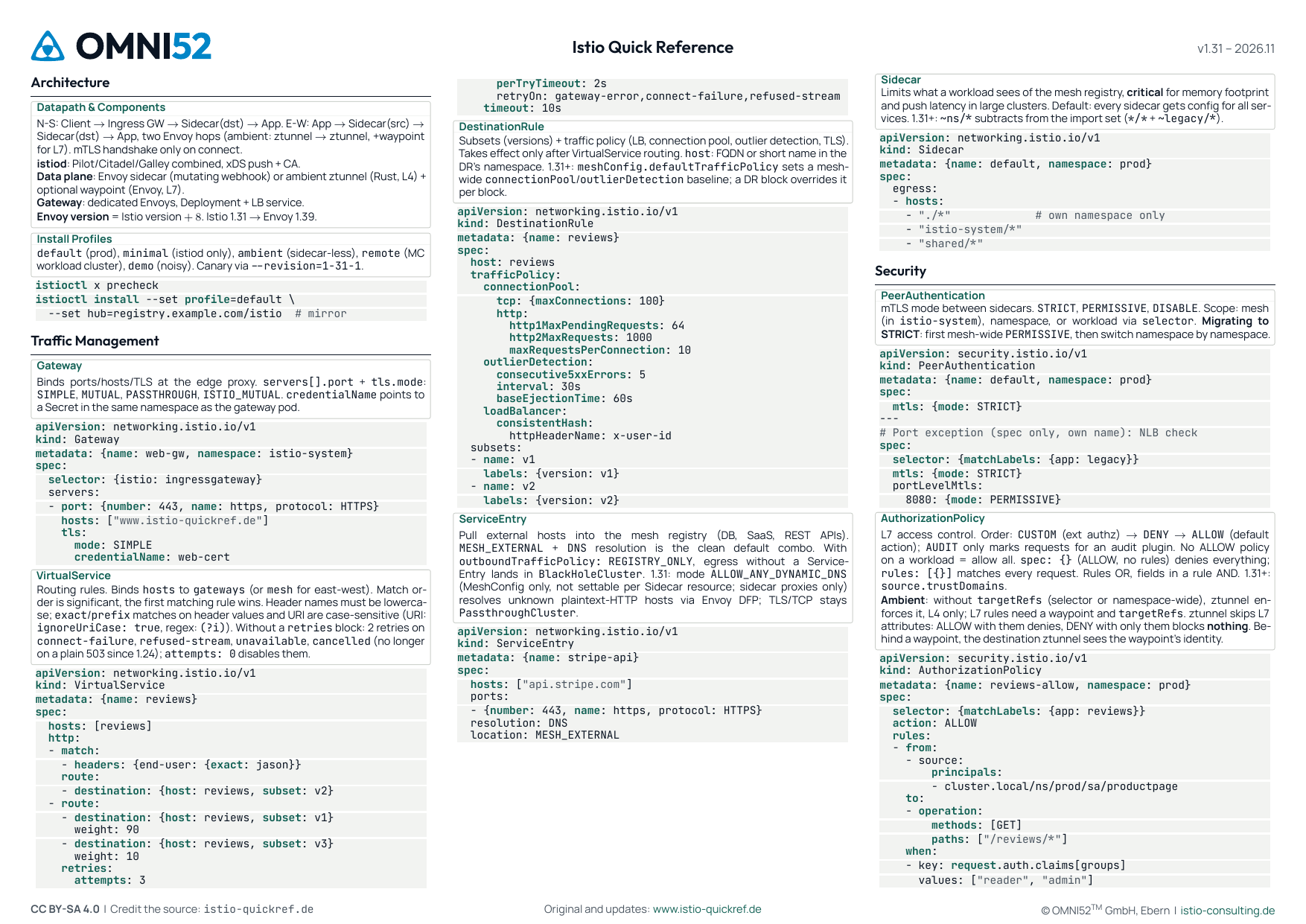
Datapath from ingress gateway to sidecar, istiod and the Envoy version, install profiles and canary installation with a revision tag.
-
Traffic Management
Gateway, VirtualService, DestinationRule, ServiceEntry and Sidecar scoping with copyable YAML, retries, outlier detection and connection-pool defaults.
-
Security
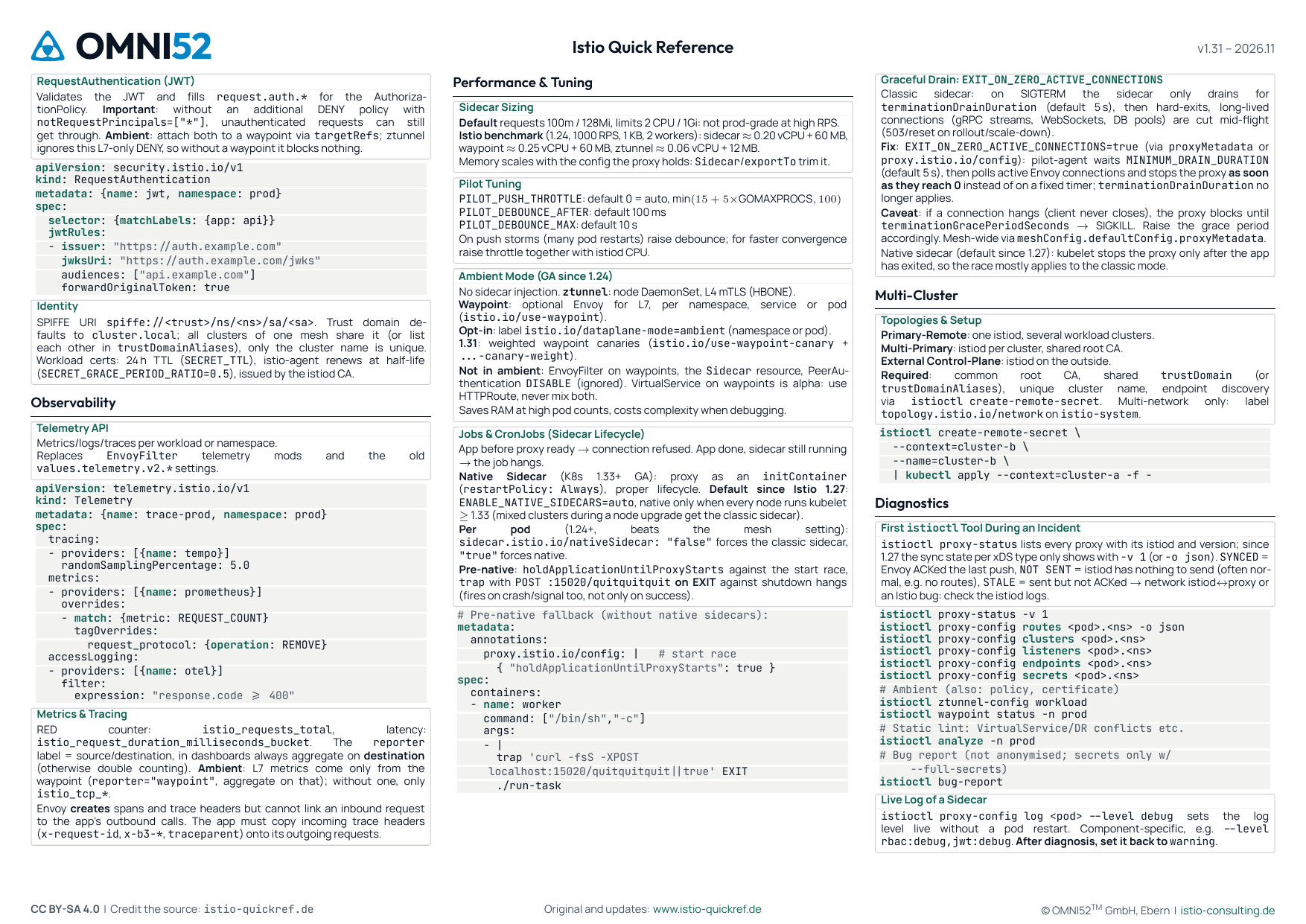
PeerAuthentication and the migration to mTLS STRICT, AuthorizationPolicy with evaluation order, RequestAuthentication for JWT and SPIFFE identity.
-
Observability
Telemetry API, standard metrics such as istio_requests_total, trace header propagation and access logging through OpenTelemetry.
-
Performance & Tuning
Sidecar sizing, Pilot tuning against push storms, ambient mode with ztunnel and waypoint, sidecars in Jobs and CronJobs, graceful drain.
-
Multi-Cluster
Primary-remote, multi-primary and external control plane topologies, shared root CA, trustDomain, meshID, clusterName and remote secrets.
-
Diagnostics
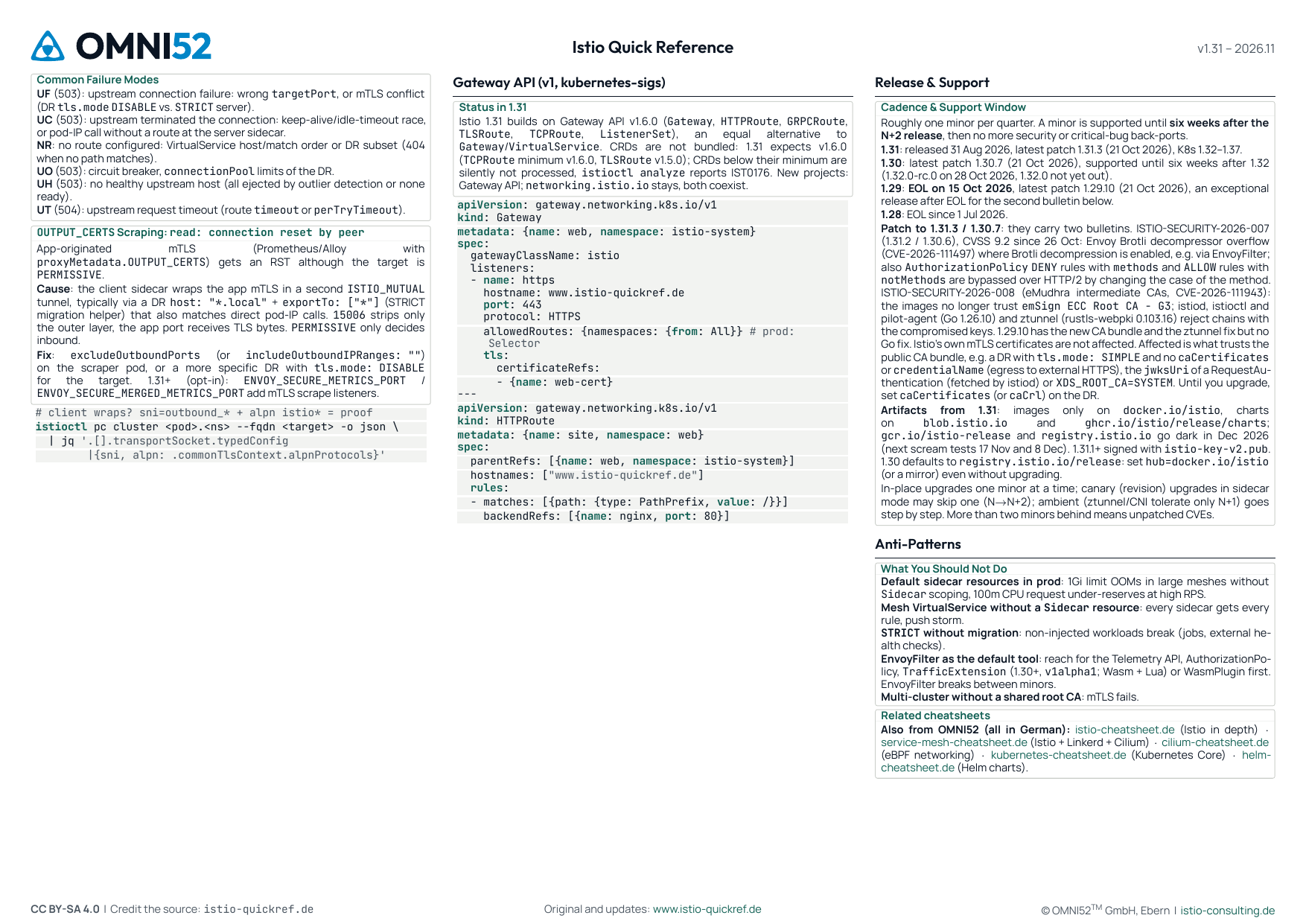
istioctl proxy-status, proxy-config and analyze in the order of an incident, sidecar logs and the failure modes 404 NR and 503 UF, UC and UH.
-
Gateway API (v1, kubernetes-sigs)
Where the Gateway API stands in Istio 1.31, CRD order during an upgrade and allowedRoutes for routes from other namespaces, with a YAML example.
-
Release & Support
Release cadence, support until six weeks after the N+2 release, in-place and canary upgrades, and the move of the image registry.
-
Anti-Patterns
What goes wrong in Istio operations: default sidecar resources, mesh VirtualServices without Sidecar scoping, STRICT without migration, EnvoyFilter as a default tool.
All chapters on one page, to search with Ctrl+F and to print.
Preview (4 pages, A4 landscape)
Download the PDF
Direct download, no email required. CC BY-SA 4.0, copying, printing and redistributing is explicitly allowed as long as the attribution stays visible.
Related cheatsheets
Also from OMNI52 (all in German):
istio-cheatsheet.de, Istio in depth
service-mesh-cheatsheet.de, Istio + Linkerd + Cilium compared
cilium-cheatsheet.de, eBPF networking
kubernetes-cheatsheet.de, Kubernetes Core
helm-cheatsheet.de, Helm charts
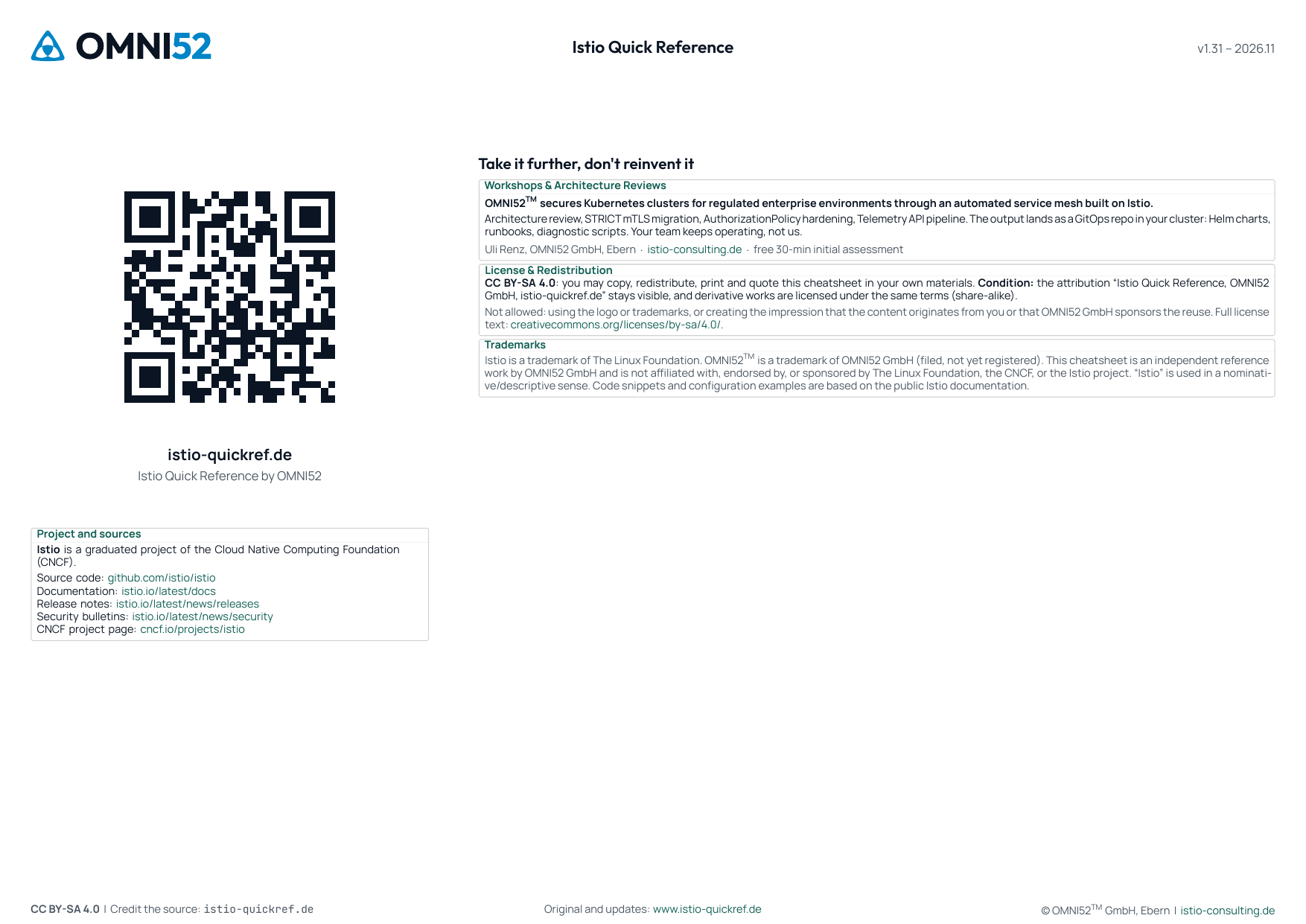
Project and sources
Istio is a graduated project of the Cloud Native
Computing Foundation (CNCF).
Source code: github.com/istio/istio
Documentation: istio.io/latest/docs
Release notes: istio.io/latest/news/releases
Security bulletins: istio.io/latest/news/security
CNCF project page: cncf.io/projects/istio
License & redistribution
Not allowed: using the logo or trademarks, or creating the impression that the content originates from you or that OMNI52 GmbH sponsors the reuse.
Full license text: creativecommons.org/licenses/by-sa/4.0/.
Istio is a trademark of The Linux Foundation. OMNI52™ is a trademark of OMNI52 GmbH (filed, not yet registered). This website is operated by OMNI52 GmbH and is not affiliated with, endorsed by, or sponsored by The Linux Foundation, the CNCF, or the Istio project. “Istio” is used in a nominative/descriptive sense to indicate the technology this reference describes.